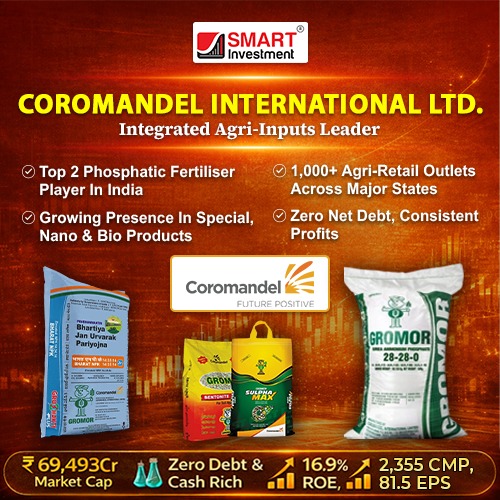
Coromandel International Ltd: Strong Agri-Input Play with Stable Cash Flows & Growth Engines
Coromandel International Ltd.
About the Company:
Coromandel International Limited is one of India’s largest integrated agri-input companies, operating across crop nutrition, crop protection, specialty and bio products, and farmer-centric retail and services. Part of the Murugappa Group and a wholly owned subsidiary of EID Parry with 62% share holding, the company plays a critical role in India’s agricultural ecosystem by supplying essential inputs that directly impact farm productivity, food security, and rural incomes.
Founded with a strong legacy in phosphatic fertilisers, Coromandel has steadily evolved into a diversified agri-solutions platform, balancing the stability of regulated fertiliser volumes with the growth potential of higher-margin segments such as crop protection, specialty nutrients, nano fertilisers and agri-services.
Business Verticals and Segment Overview
1) Crop Nutrition (Fertilisers)
Crop nutrition remains Coromandel’s largest and most stable business, forming the backbone of revenues and cash flows.
- The company is among the top two phosphatic fertiliser players in India and the largest Single Super Phosphate (SSP) manufacturer in the country.
- Coromandel has a strong presence across DAP, complex NPK fertilisers, SSP and fortified variants, supplying over 6 million tonnes annually.
- It commands a leading market share in complex fertilisers and SSP, with especially strong penetration in southern and western India.
The fertiliser business benefits from:
- Large-scale manufacturing
- Established dealer and distributor networks
- Long-term raw material sourcing arrangements
- Strong brand recall among farmers
While fertilisers are a regulated and subsidy-linked segment, Coromandel’s scale and operating efficiencies allow it to generate predictable volumes and stable operating cash flows, even during volatile commodity cycles.
2) Specialty Nutrients and Nano Fertilisers
To reduce dependence on commodity fertilisers, Coromandel has aggressively expanded its specialty nutrition portfolio, which includes:
- Water-soluble fertilisers
- Micronutrients and secondary nutrients
- Crop-specific nutrient solutions
- Organic fertilisers and soil conditioners
- Nano fertilisers (including Nano DAP)
This segment is structurally important as it offers:
- Higher margins
- Lower working capital intensity
- Minimal subsidy exposure
- Strong farmer stickiness due to crop-specific solutions
Coromandel is currently one of the leading players in India’s nano fertiliser segment, with a significant share in Nano DAP. Specialty and nano products, though smaller in revenue contribution today, are growing faster than the core fertiliser business and are expected to steadily improve blended margins over the medium term.
3) Crop Protection
Crop protection has emerged as Coromandel’s second growth engine.
- The company offers a diversified portfolio of insecticides, fungicides, herbicides, plant growth regulators and soil health products.
- Over the years, Coromandel has strengthened this vertical through portfolio expansion and strategic acquisitions, enabling it to rank among the top domestic crop protection companies.
- The portfolio comprises 90+ products, with increasing presence across both formulations and select technicals.
Crop protection provides:
- Better return ratios compared to fertilisers
- Lower regulatory price controls
- Higher export potential
However, it is also more cyclical and sensitive to monsoons, pest incidence and inventory corrections. Over a full cycle, this segment acts as a margin enhancer and a key diversification lever for the company.
4) Bio Products and Sustainable Solutions
Coromandel has built a sizeable presence in bio products, aligned with sustainability and residue-free farming trends.
- The portfolio includes bio-insecticides, bio-fungicides, neem-based solutions and natural growth promoters.
- The company is among the largest neem-based bio solution producers, with certifications allowing exports to multiple international markets.
While bio products currently contribute a smaller share of revenues, they are strategically significant due to:
- Rising global demand for sustainable agri-inputs
- Increasing residue compliance requirements for exports
- Long-term soil health considerations
5) Retail, Advisory and Farm Services
One of Coromandel’s key differentiators is its large, organised agri-retail and services network.
- The company operates 1,000+ agri-retail outlets across major agricultural states.
- It directly engages with over 3 million farmers through physical stores, field teams and digital platforms.
Services offered include:
- Soil and leaf testing
- Crop planning and advisory
- Precision agriculture solutions
- Drone spraying services
- Farm mechanisation support
- Digital tools for diagnostics and recommendations
From a fundamental perspective, the retail and services business:
- Improves demand visibility
- Enhances cross-selling across fertilisers, crop protection and specialty products
- Strengthens farmer loyalty
- Reduces dependence on third-party distribution
Manufacturing and R&D Capabilities
- 20+ manufacturing facilities across India covering fertilisers, crop protection, bio products and intermediates.
- Integrated plants with high capacity utilisation levels.
- Dedicated R&D centres focused on:
- Product innovation
- Process improvement
- Sustainable solutions
- Agronomy-led field trials
This integrated setup allows Coromandel to balance scale, efficiency and innovation.
Geographic Presence and Global Operations
Domestic Market
India remains Coromandel’s primary revenue base, with a strong footprint inAndhra Pradesh, Telangana, Karnataka, Tamil Nadu, Maharashtra and Madhya Pradesh and select northern states
Its distribution network spans over 100,000 dealer and retailer touchpoints, ensuring deep penetration across key crop belts.
International Presence
Coromandel has built a meaningful international footprint, particularly in crop protection and specialty products.
- Exports to ~80 countries across Latin America, Africa, Asia-Pacific and select developed markets.
- Overseas subsidiaries and partnerships in countries such as Brazil, Australia, Mexico, Nigeria, Philippines, Mauritius and parts of Europe.
- International operations focus on branded generics, formulations and niche specialty products rather than bulk fertilisers.
Additionally, Coromandel has made strategic investments in overseas raw material assets (rock phosphate and phosphoric acid) to secure long-term input availability and reduce cost volatility.
KPI:
|
CMP |
2,355 |
|
52 - week high / low |
Rs. 2,720 / 1,590 |
|
Dividend % (consolidated) |
0.51% |
|
ROE |
16.9% |
|
BV(Rs.) |
413 |
|
Sales (Rs.) |
28,620 Cr. |
|
Debt to Equity |
0.12 |
|
P/E ratio |
32.7 |
|
EPS (consolidated) |
Rs. 81.5 |
|
P/B ratio |
5.70 |
|
Market Cap (Rs.) |
69,493Cr. |
|
Face value (Rs.) |
1 |
|
PEG Ratio |
7.89 |
|
EVEBITDA |
19.9 |

Financial Results:
Coromandel International has delivered consistent topline growth over the last two financial years, supported by strong nutrient volumes and steady expansion in crop protection.
FY24
- Revenue remained resilient despite volatility in global fertiliser input prices.
- Nutrient volumes were stable, supported by timely availability and strong dealer reach.
- Crop protection delivered healthy growth, aided by portfolio expansion and better channel penetration.
FY25
- Consolidated revenue crossed ₹24,000 crore, marking a strong year-on-year increase.
- Nutrient & allied revenues grew meaningfully, driven by higher volumes and improved product mix.
- Crop protection revenues rose to ₹2,637 crore, reflecting continued traction in domestic formulations and exports.
Recent Quarter (Q2 / Q3 FY26 – latest reported)
- Quarterly revenue growth remained robust, supported by peak-season fertiliser dispatches.
- Crop protection sales showed sequential improvement, aided by better monsoon distribution and normalization of channel inventories.
- Demand visibility remained healthy across key southern and western states.
Key takeaway:
Growth has been volume-led and execution-driven, rather than price-led, indicating sustainable demand rather than one-off benefits.
2) Segment-wise Performance
Nutrients & Allied Business
- Continues to contribute ~88–89% of consolidated revenue.
- Fertiliser production and dispatch volumes remained strong across DAP, NPKs and SSP.
- Backward integration into phosphoric acid helped cushion margin volatility during periods of raw material price swings.
- Specialty and fortified fertilisers improved blended realizations.
Despite being regulated, the nutrients business continues to act as a stable cash flow engine, supporting dividends and reinvestment.
Crop Protection Business
- Revenue growth of ~100% over the last few years, with FY25 revenues at ₹2,637 crore.
- In the last two fiscals, crop protection has consistently grown faster than the fertiliser segment.
- Higher contribution from proprietary formulations and branded products supported margins.
From a financial quality perspective, crop protection:
- Contributes a lower share of revenue but a higher share of incremental EBITDA
- Reduces subsidy dependence
- Improves overall return ratios
Margin and Profitability Analysis
Operating Margins
- EBITDA margins remained broadly stable in the 10–11% range over FY24 and FY25.
- Margin resilience was achieved despite:
- Volatile global phosphoric acid prices
- Subsidy timing differences
- Competitive pressure in crop protection
Recent Quarter
- Margins showed sequential stability, supported by:
- Higher fertiliser plant utilization
- Better absorption of fixed costs
- Improving mix from crop protection and specialty products
PAT Performance
- FY25 PAT exceeded ₹2,000 crore, reflecting strong operating leverage.
- Profit growth outpaced revenue growth, indicating improving earnings quality.
- Recent quarterly PAT growth remained healthy, supported by lower finance costs and stable tax rates.
Cost Structure and Efficiency
- Raw material costs remain the largest cost component, especially for phosphatic inputs.
- Increased in-house phosphoric acid production reduced exposure to spot market volatility.
- Distribution and logistics efficiencies improved through:
- Retail integration
- Better inventory planning
- Higher throughput at manufacturing units
Safety and execution discipline (low TRIR levels) continue to support higher plant uptime and lower disruption-related costs.
Balance Sheet and Liquidity Position
Coromandel continues to maintain a strong and conservative balance sheet.
- Net debt: Zero / net cash position
- Strong cash and liquid investments
- No stress from interest servicing
- Working capital requirements remain manageable despite fertiliser subsidy cycles
This balance sheet strength provides flexibility to:
- Absorb short-term subsidy delays
- Fund capex in specialty, bio and crop protection
- Pursue selective acquisitions without leverage stress
Cash Flow and Capital Allocation
- Operating cash flows remain strong over the cycle.
- Temporary fluctuations are largely linked to subsidy receivables rather than operational weakness.
- Capital expenditure over the last two fiscals has been focused on:
- Specialty and nano fertilisers
- Crop protection capacity and registrations
- Retail and digital platforms
- Backward integration projects
Capital allocation remains measured and return-focused, avoiding aggressive expansion.
Return Ratios and Shareholder Metrics
- ROCE and ROE remain in the healthy mid-to-high teens, even during periods of elevated working capital.
- Asset turns remain strong due to high utilisation of manufacturing and distribution assets.
- Dividend payouts have remained consistent, supported by cash generation.
Financial Strengths:
- Stable base cash flows from fertilisers
- Higher-margin growth engines scaling steadily
- Zero net debt and strong liquidity
- Healthy return ratios through cycles
- Ability to self-fund growth
Segmental Strengths:
- Fertilisers: Volume stability, scale advantage, cash flow visibility
- Crop Protection: Margin expansion and growth optionality
- Specialty & Nano Products: Structural margin uplift over time
- Retail & Services: Distribution control and farmer stickiness
- International Business: Diversification and export optionality
Key Risks to Monitor :
- Fertiliser subsidy policy and timing of reimbursements
- Volatility in global phosphoric acid and ammonia prices
- Monsoon variability impacting demand
- Inventory cycles in crop protection
- Regulatory changes in agrochemicals
Conclusion:
Coromandel International’s fundamentals align well with the broader structural evolution underway in India’s agricultural inputs market. The country’s gross cropped area of over 195 million hectares continues to demand higher nutrient efficiency as soil nutrient imbalance remains a key concern, with nitrogen-heavy usage still dominating fertiliser application. Policy initiatives promoting balanced fertilisation, fortified nutrients and soil health cards are gradually shifting demand toward complex fertilisers and customised solutions—segments where organised, scale players are better positioned than smaller, unorganised participants.
From a market perspective, the agri-inputs industry is entering a phase of value migration rather than pure volume growth. While overall fertiliser demand is expected to grow at a modest 3–4% annually, specialty nutrients, bio inputs and precision crop protection solutions are projected to grow at 2–3 times that rate, driven by climate variability, rising pest resistance and the need for yield optimisation. Additionally, India’s agri-chemical exports—already among the top global suppliers—are expected to benefit from supply chain diversification away from China, creating medium-term opportunities for companies with registrations, formulations and compliance capabilities.
Within this evolving landscape, integrated agribusiness models with strong balance sheets, distribution control and product breadth are likely to gain share. Risks such as monsoon variability, regulatory changes and commodity price volatility remain inherent, but industry consolidation and increasing farmer preference for trusted brands provide structural downside protection. Against this backdrop, Coromandel’s business model offers investors exposure to India’s agricultural transformation theme, where steady cash flows from essentials combine with long-term growth from value-added inputs—an attractive risk-reward equation for patient, fundamentals-driven investors.
HET ZAVERI
info@smartinvestment.in
(Disclosures: At the time of writing this article, author, his clients & dependent family members may have positions in the stocks mentioned above. The author, his firm, his clients or any of his dependent family members may make purchases or sale of the securities mentioned in website. Author may have positions in above stocks so have vested interest obviously in their going up or down as the case may be.
Disclaimer: Investing in any equity is risky. Above information is for educational purpose only. It is based on reliable & authenticated sources believed to be true & correct. Investors should take their own decisions. We assume no responsibility for any transactions undertaken by them. The author won't be liable or responsible for any legal or financial losses made by anybody. Investors must take advice from their financial advisors before investing in any stocks.)