Adani Power Ltd - Research Report
Adani Power Ltd.
About the Company:
Adani Power (APL), a part of the diversified Adani Group, is the largest private thermal power producer in India. Adani Power operates under the broader Adani Group’s infrastructure and energy portfolio, which includes power generation, transmission, distribution, renewable energy, and international power exports. It supplies power through long-term Power Purchase Agreements (PPAs) with state electricity boards and industrial consumers, while also engaging in merchant power sales with in-house coal logistics.
APL produces thermal power using coal-fired technology and supplies both base load and peak demand electricity. APL’s power plants use technology, with over 74% of its generation portfolio employing supercritical and ultra-supercritical technology.
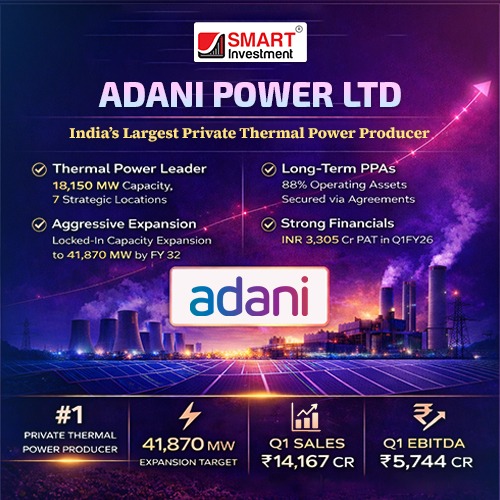
It operates a power generation capacity of 18,150 MW including 15,210 MW, of thermal power plants and a 40 MW solar power project. Company has also Locked-in Capacity expansion of 23720 MW which is to be completed by Fy32 making its total capacity increased upto 41,870 MW. Out of total operating assets 88% are PPAs Tied up. Company’s 69% of upcoming capacity is brownfield, enabling faster project execution.
APL owns and operates multiple large-scale power plants across 7 Indian states, strategically positioned to meet regional demand efficiently. The locations indlude Mundra, Gujarat: 4,620 MW (Coastal, Supercritical & Subcritical), Tiroda, Maharashtra: 3,300 MW (Near pithead, Supercritical), Kawai, Rajasthan: 1,320 MW (Hinterland, Supercritical), Udupi, Karnataka: 1,200 MW (Coastal, Subcritical), Raipur, Chhattisgarh: 1,370 MW (Near pithead, Supercritical), Raigarh, Chhattisgarh: 600 MW (Near pithead, Subcritical), Singrauli, Madhya Pradesh: 1,200 MW (Near pithead, Subcritical), Godda, Jharkhand: 1,600 MW (Hinterland, Ultra-supercritical) and Bitta, Gujarat: 40 MWp (Solar Power Plant).
Most of the APL’s power generation is tied up in long-term PPAs with state utilities such as Maharashtra State Electricity Distribution Co. Ltd. (MSEDCL), Gujarat Urja Vikas Nigam Limited (GUVNL), and Rajasthan Urja Vikas Nigam Limited (RUVNL). APJL (wholly-owned subsidiary of the Company) is creating a 1,600 MW greenfield ultra supercritical power project in Jharkhand to supply power to Bangladesh. Adani Power was the first company to implement and commission 660 MW supercritical technology units in India.
APL has allocated significant capital expenditure for expansion of 14,170 Crs in FY24 for capacity expansion, acquisitions, and technology upgrades. New projects include 1,600 MW Mahan Phase II Ultra-Supercritical Plant and 1,600 MW expansion at Raigarh, Chhattisgarh. Company has already invested in digital infrastructure such as Project Beacon for analytics-driven operations and Energy Network Operations Center (ENOC) for centralized monitoring.
Fundamentals:
|
CMP |
652 |
|
52 - week high / low |
Rs. 682 / 431 |
|
Dividend % (consolidated) |
0% |
|
ROE |
26.1% |
|
BV(Rs.) |
146 |
|
Sales (Rs.) |
55,357Cr. |
|
Debt to Equity |
0.7 |
|
P/E ratio |
19.3 |
|
EPS (consolidated) |
Rs. 32.2 |
|
P/B ratio |
4.28 |
|
Market Cap (Rs.) |
240847 Cr. |
|
Face value (Rs.) |
10 |
|
PEG Ratio |
0.51 |
|
EVEBITDA |
11.7 |

Financial Results:
Adani Power delivered robust Q1 FY26 results with a consolidated revenue of Rs. 14,167 crores marking a growth of 8.8% YoY, EBITDA of Rs. 5,744 crores marking a growth of 20.5% YoY, and profit after tax of Rs. 3,305 crores marking a growth of 27.1% YoY, demonstrating resilience despite softer tariffs and a challenging demand environment.
Latets Updates:
- Adani Power and Druk Green Power Corp. Ltd. (DGPC), Bhutan’s state-owned generation utility recently signed the Shareholders Agreement (SHA) for setting up a 570 MW Wangchhu hydroelectric project in the Himalayan Kingdom of Bhutan. The developers also signed the Concession Agreement (CA) for the project with the Royal Government of Bhutan. The Wangchhu project will see an investment of about INR 60 billion in setting up the renewable energy power plant and related infrastructures. With the preparation of the detailed project report already completed, construction work is expected to begin by the first half of 2026, and the completion is targeted within five years of groundbreaking.
- Adani Power Ltd. (APL), has been awarded a total of 1600 MW capacity by MP Power Management Company Limited (MPPMCL) under the recently concluded tendering process. APL received a Letter of Award (LoA) today from MPPMCL, awarding 800 MW additional capacity under ‘Greenshoe Option’. This comes on the back of APL’s earlier success in winning an initial 800 MW capacity in the same bidding process. This is the fifth major power supply order received by the company in the last 12 months, taking the total awarded capacity to 7,200 MW. This additional capacity of 800 MW awarded is at the same tariff of Rs. 5.838 / kWh applicable to the earlier awarded 800 MW capacity. Accordingly, APL will supply power from a new 1600 MW (800MW X 2) Ultra-supercritical thermal power unit, to be set up under the Design, Build, Finance, Own, and Operate (DBFOO) model, in Anuppur district of Madhya Pradesh. Both the units will be commissioned within 60 months of the appointed date. The company will invest around Rs 21,000 crore towards setting up the plant and related infrastructure.
- Company has also received a Letter of Award (LoA) from MP Power Management Company Ltd. (MPPMCL) for supply of power from a new 800 MW Ultra-supercritical thermal power plant to be developed in Anuppur district of MP.
The said project will help Madhya Pradesh to meet its ever-growing electricity demand owing to increased industrialization and urbanisation. The company will invest ~10,500 crore towards setting up the plant and related infrastructure with the final tariff of Rs 5.838 per KWh. As part of the contract, the Company will supply power from a new 800 MW Ultra-supercritical thermal power unit, to be set up under the Design, Build, Finance, Own, and Operate (DBFOO) model, in the state.
- Company also has received a Letter of Award (LoA) for 25 Years long term procurement of electricity from Bihar State Power Generation Company Ltd. (BSPGCL), which it will supply from a 2,400 MW (800 MW X 3) greenfield ultra super critical plant to be set up at Pirpainti in Bhagalpur district of Bihar.
- Company has recently acquired Vidarbha Industries Power Ltd. (VIPL) for an aggregate consideration of INR 4,000 crore. VIPL is a 2×300 MW domestic coal-fired power plant located in Butibori, Nagpur district, Maharashtra.
- Company also won a tightly contested bid to supply 1500 MW (net) of thermal power to Uttar Pradesh. As part of the contract, the Company will supply power at a highly competitive tariff of Rs 5.383 per unit from a greenfield 2x800 MW (1500 MW net) Ultra-supercritical power plant to be set up under the Design, Build, Finance, Own, and Operate (DBFOO) model in the state.
- Company has also signed a long-term Power Purchase Agreement (PPA) with Maharashtra State Electricity Distribution Company Limited (MSEDCL) under the Letter of Intent (LOI), for supply of 5 GW (5000 MW) solar power from the world’s largest renewable energy park being developed at Khavda in Kutch District of Gujarat, to Maharashtra state, as per the LOI awarded to Adani Power Limited as permitted under the tender conditions. It has also signed a long-term Power Supply Agreement (PSA) with MSEDCL for supply of 1496 MW (net) thermal power to Maharashtra state from a new 1600 MW Ultra-supercritical thermal power project.
Conclusion:
Adani Power Limited stands as a key beneficiary of India’s surging electricity demand, rising industrial activity, and government push for reliable base-load capacity. While its fundamentals show strength through improved operational efficiency, debt management, and capacity expansion, investor caution is warranted given exposure to regulatory risks and commodity price volatility.
Looking ahead, India’s power sector is poised for robust growth, driven by rapid urbanization, digital infrastructure, electric mobility, and the government’s ambitious target of achieving 500 GW of renewable capacity by 2030. Thermal power, however, will remain relevant in the medium term as a bridge to support intermittent renewable supply.
For investors, Adani Power offers a mix of short- to medium-term earnings resilience from coal-based assets and long-term opportunities if the company accelerates its transition into cleaner energy. Thus, it remains a strategic play on India’s evolving energy mix, where traditional and renewable power will co-exist over the coming decade.
HET ZAVERI
info@smartinvestment.in
(Disclosures: At the time of writing this article, author, his clients & dependent family members may have positions in the stocks mentioned above. The author, his firm, his clients or any of his dependent family members may make purchases or sale of the securities mentioned in website. Author may have positions in above stocks so have vested interest obviously in their going up or down as the case may be.
Disclaimer: Investing in any equity is risky. Our recommendations are based on reliable & authenticated sources believed to be true & correct, and also is technical analysis based on & conceived from charts. Investors should take their own decisions. We assume no responsibility for any transactions undertaken by them. The author won't be liable or responsible for any legal or financial losses made by anybody. Investors must take advice from their financial advisors before investing in any stocks.)